
Caddo Parish Busted Mugshot Records
What actually happens after an arrest in Caddo Parish? The jail books the person. Staff log the name and identity details, the arresting agency, the charges, bond terms, physical descriptors, and each custody event. A booking photo gets taken for identification. Where that record begins depends on who made the arrest. It might start in the Shreveport City Jail system, or it might start at Caddo Correctional Center, the parish jail the Caddo Parish Sheriff's Office runs. A transfer can link the two. Even so, they stay separate systems with separate records.
Each source covers only what it covers. A dated City Jail report lists the people processed in that window, nothing more. The CPSO Inmate Listing reflects the sheriff's local custody interface and can include older booking-history rows. Entries vanish after release even when a court case is still open. And a photo placeholder may reflect Louisiana publication law rather than a missing booking photo.
What Caddo Booking Records Show
The two agencies show different fields. A sheriff detail page can include an SO number, a jacket number, identity data, and the full booking and release history. Shreveport's daily report goes further in other areas. It adds the arresting agency, warrant authority, bond fields, and a yes/no image indicator. Keep one thing in mind. A charge label records what was typed in at intake, not what prosecutors later accepted.
| Field | Meaning |
|---|---|
| Name and identifiers | The listed person, checked against date of birth and agency numbers. |
| Booked or confined date | The intake date or time, not a conviction date. |
| Arresting agency | The office reported as making or processing the arrest. |
| Charge and warrant | The charges or legal authority recorded at booking. |
| Bond | The entry at that point; later court action may change it. |
| Image indicator | An administrative photo field, not a guarantee of a public copy. |
| Release history | Past custody events, not necessarily current custody. |
Numbers matter when you ask for a file. Use the SO number, jacket number, or booking number whenever you have one. Common names need extra care. Compare the birth date, the physical description, the booked date, and the agency before you decide two entries belong to the same person.
Two Caddo Booking Systems
Shreveport's City Jail page organizes its reports by date. Each prior-day window carries a printed time and a detailed table. That makes it handy for City Jail intake. It is not, however, a live parish roster. The agency and warrant fields may point to SPD, to CPSO, or to some other office entirely.
Caddo Correctional Center lives in the sheriff's current-inmate interface. You can search by name or letter, filter, sort, and view booking history. Official CPSO releases confirm that some people booked first at City Jail transfer to CCC later. So a person might show up in one source, in both at different times, or in neither once released.
| Source | Window | Best use |
|---|---|---|
| Shreveport report | A named date | Confirm municipal intake and agency fields. |
| CPSO roster | Current CCC custody plus history | Check parish custody and detail. |
| Caddo court | Post-booking | Follow filings and disposition. |
Note: Sorting the roster by booking date will not produce a complete daily Caddo arrest log.
Request Caddo Busted Mugshot Records
Sometimes the record you want is no longer current, or the public photo is simply absent. That is the moment for the CPSO public-record form. The form asks for a specific description and a custodian category. Keep your request narrow. It helps the office tell the booking sheet apart from the photograph, and the photo has its own separate legal limits.
- Give the name, booking date or range, and arresting agency.
- Add the SO, jacket, report, or docket number if known.
- Name each requested item, including the booking sheet, bond or release entry, and any legally releasable photo.
- Ask for the legal basis for a withheld item.
- Keep the request, estimate, response, and redaction notice.
501 Texas Street, Room 101
Shreveport, LA 71101
318-675-2170
Generally Monday through Friday, 8:30 a.m. to 5 p.m.
CPSO cites R.S. 44:32 on access and fees, but it posts no set booking-photo price and no guaranteed production time. There is one firm deadline, though. When a request calls for a legal determination, Louisiana law requires written notice within five working days, not counting weekends and legal holidays. Be careful here. That notice deadline is not a promise of production within five days.
Louisiana Mugshot Publication Law
Louisiana limits booking-photo release and publication through Act 494 and Code of Criminal Procedure article 234, unless an exception applies. The exceptions are specific. A fugitive notice that might aid an arrest counts, as do an imminent threat, a judge's order, certain serious offenses, a qualifying conviction or plea, or a request from the subject or counsel. For anything else, the official Act 494 text controls.
CPSO states that eligible images appear in its roster and app. So a genuine booking record can still carry a placeholder where the photo would be. The official roster shows its search controls, its selective-photo state, and this warning:
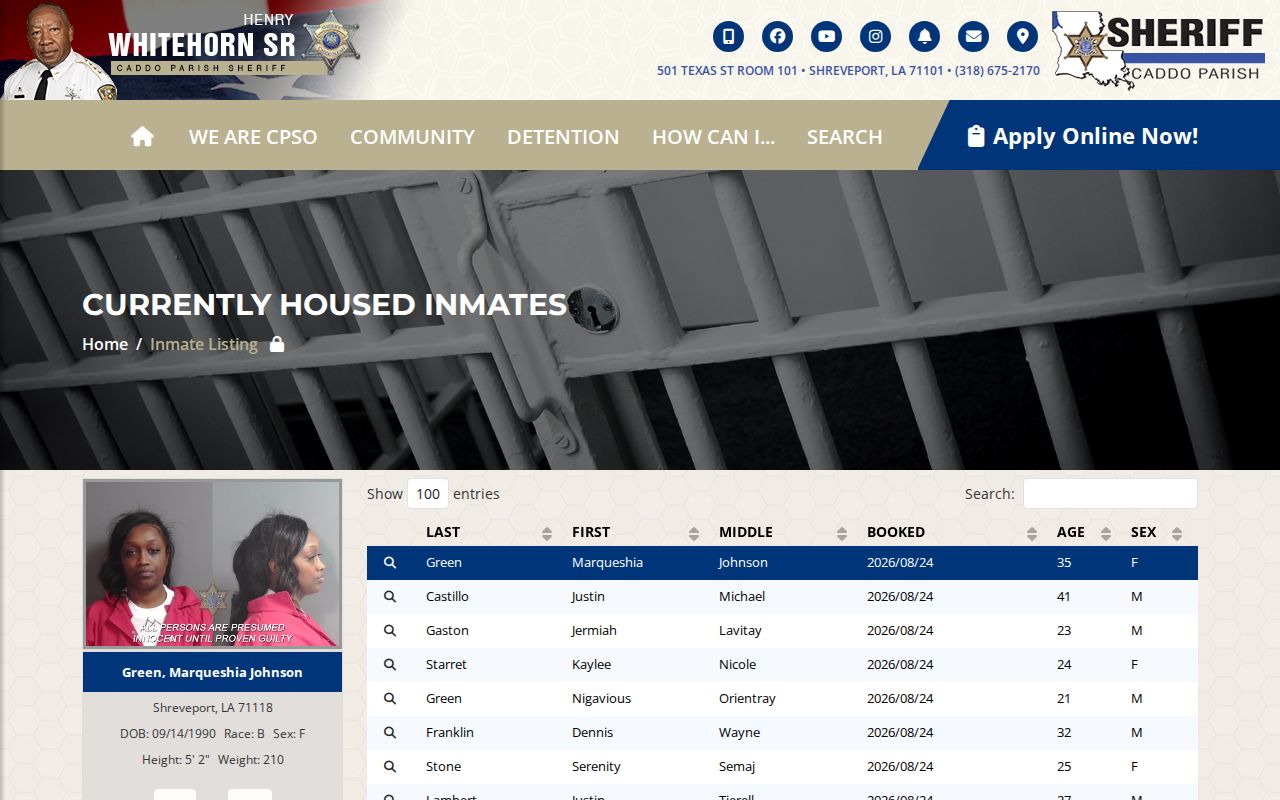
Think of the interface as a path to the agency record, never as a source for republishing photos. R.S. 44:32 governs inspection, copies, and fees. Even so, public booking data can carry separate photo restrictions that stand on their own.
Correct Caddo Mugshot Publications
Start a correction by saving the basics. Keep the source URL, the date, the agency number, and the docket. A wrong identity, charge, photo, or date goes first to the office or publisher that created it. For an acquittal, a non-prosecution, an expungement, a vacation, or a pardon, get court proof. Article 234 then offers a route: a no-fee, seven-day removal from a qualifying pay-for-removal publication once proof is supplied. It does not erase every agency and court record.
The Caddo Clerk procedure requires one motion per arrest, service on the State, the DA, and the Sheriff, and it runs about six months. Expect payments of $200 to the Clerk, $250 to the state identification bureau, $50 to the Sheriff, and $50 to the DA, plus certified-copy costs. Eligibility turns on the facts, so follow the current instructions.
On the private side, RecentlyBooked and JailRosters publish free correction or removal paths. Arrests.org lists contact information but no clear free policy, while Mugshots.com posts only general site policies. None of them is official. No paid vendor gets a recommendation here. Once a source changes, Google's outdated-content process may refresh a stale search result.
Search Caddo Busted Jail Records
For current custody at CCC, the CPSO roster is the main source. Begin with a surname or a single letter, then narrow and sort from there. One caution applies. The newest date is not a full list of parish arrests, and custody status changes fast.
| Control | Use |
|---|---|
| Last-name letters | Browse by surname initial. |
| Last-name search | Find a known surname. |
| Sex filter | Narrow Male or Female. |
| Name sort | Order surnames. |
| Age sort | Youngest or oldest. |
| Booking-date sort | Most recent or oldest. |
- Search the surname, then try its initial if spelling may vary.
- Match the full name, age, sex, physical details, and booked date.
- Open the detail and compare the SO or jacket number.
- Check again before relying on custody status.
Not every record shows a photo. Some carry a link, and some show a placeholder instead. CPSO publishes no fixed refresh interval and no online retention term. Older booking-history rows do prove some persistence, but they are not a uniform rule.
Recent Caddo Busted Bookings
Caddo Parish has no same-day official booking feed from the Sheriff's Office. The CPSO roster reflects custody at the Correctional Center, and press releases only highlight selected incidents. Want a specific parish date range? Ask the records custodian directly.
Shreveport does it better. City Jail reports usually arrive the next morning, covering the prior day's arrests. Daily PDFs sit in archives sorted by year, from 2024 through 2026. Each report lists the person's identity, confinement time, arresting agency, charges, warrants, bond, and whether an image appears. One caveat: that archive skips arrests made in Blanchard, Greenwood, and rural parts of the parish.
Private sites offer partial pictures of Caddo bookings. RecentlyBooked claims a rolling 30-day window. JailRosters posts private PDF snapshots, and Arrests.org organizes entries by dated paths. All of them can lag or keep stale entries around. For anything that matters, official and court sources carry the final word.
Where Caddo Busted Mugshots Appear
Start with official sources. News coverage and private indexes can help you find a name, but their dates and labels often drift out of sync with what the government actually recorded.
| Channel | Photo? | Status |
|---|---|---|
| CPSO roster | Selective | Official current CCC source. |
| Shreveport reports | Indicator | Official dated City Jail source. |
| CPSO request | If releasable | Official fallback. |
| DPS&C/VINE | No promise | State custody and alerts. |
| Local news | Sometimes | Selected stories. |
| Private indexes | Often | Unofficial and possibly stale. |
Several private indexes maintain Caddo sections: RecentlyBooked, Mugshots.com, Arrests.org, and JailRosters. Busted Newspaper and Mugshots Zone did not. Whatever a private site shows, confirm it against the Sheriff's Office, Shreveport, or the court before trusting it.
Caddo Booking Alerts and App
The CPSO app works as a service hub. It bundles Current Inmates, Active Warrants, tip submission, notifications, social media, and 9-1-1 access in one place. Think of it as a doorway, not a new booking database or a wider photo policy. The PWA menu lays out those official shortcuts:
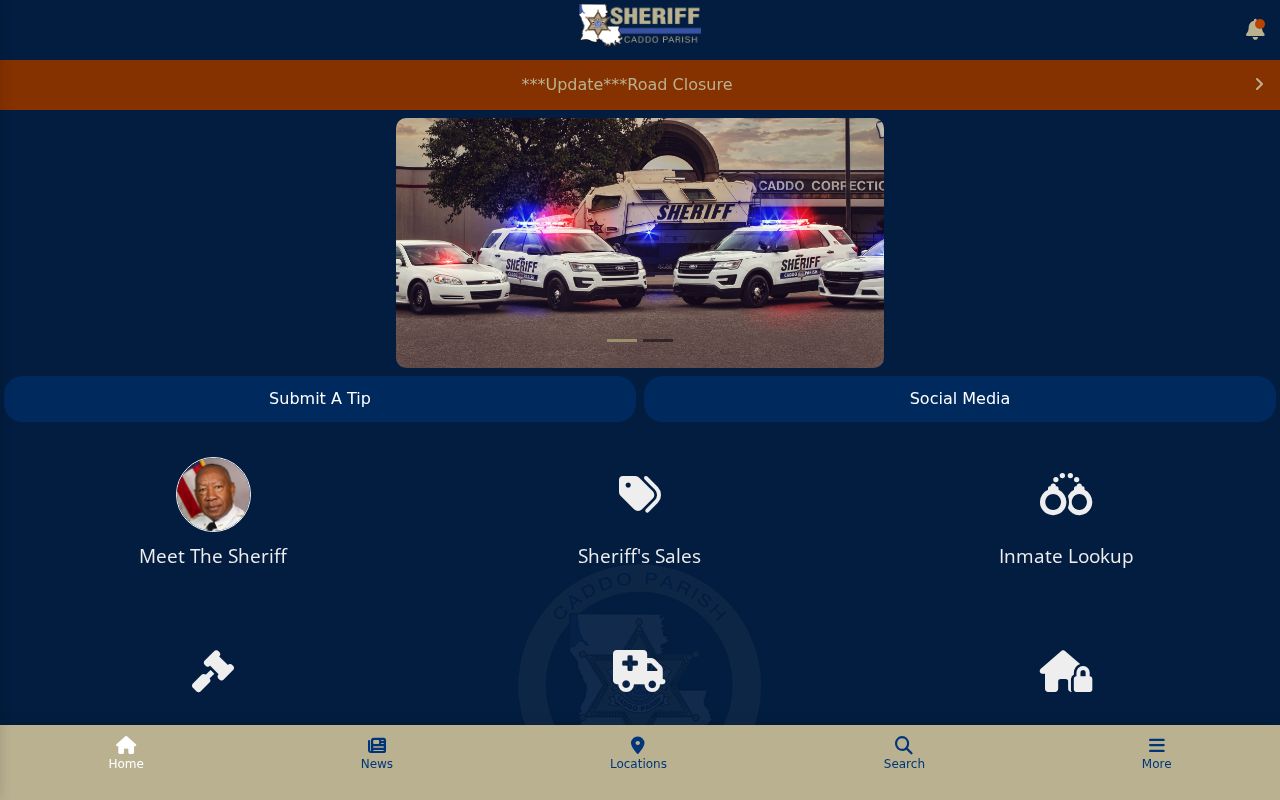
Each service inside the app does its own job, so use it that way. Louisiana VINE handles custody notifications separately. It is not a public photo index.
Caddo Arrest Custody Changes
Custody shifts as a case moves. Someone booked in a Shreveport report may land at CCC, then drop off the live roster while the case is still open. After state sentencing, Louisiana DPS&C becomes the custodial authority, and its locator information refreshes every 24 hours. Federal inmates fall under the BOP, whose records reach back to 1982 but include no public photo stream. ICE applies its own identity rules.
| Stage | Start here |
|---|---|
| City Jail intake | Shreveport dated report |
| CCC custody | CPSO roster |
| Released | Agency request and court |
| State custody | DPS&C or VINE |
| Federal | BOP locator |
| Immigration | ICE locator |
After Caddo Busted Bookings
Once a booking is behind someone, the court record tells the story. The Caddo Clerk criminal page is the gateway. It connects you to case access, daily dockets, court dates, and expungement material. Indexed cases start in 1980. Minutes begin in 1984, and scanned documents in 2002. The DA search takes a name or docket number. It does warn that the data comes as-is, so treat it as a pointer rather than a certified copy. Arraignments, filings, continuances, and outcomes can all be tracked there.
Caddo Busted Mugshots by City
Shreveport has dated City Jail reports. Blanchard and Greenwood publish police contacts but no dedicated daily blotter found in the audit. Their cases may reach CCC, but each record still needs an agency and date check.
- Shreveport Busted Mugshots: City Jail, SPD, transfers, and CCC.
- Blanchard Busted Mugshots: police contact and parish-jail handoff.
- Greenwood Busted Mugshots: town records and CPSO paths.
A city shown in an address does not establish the arresting agency.
Older Caddo Busted Arrest Records
Nothing in CPSO's online setup promises how long a roster card, a booking-history row, or an eligible photo will stay posted. One record lingering for years shows only that it lasted. It is not a parish-wide rule. The legal backbone sits elsewhere. Louisiana R.S. 44:36 makes agencies keep records for statutory periods or approved schedules, and the Louisiana State Archives runs that schedule framework. A web page can vanish long before the underlying record reaches its authorized end.
So start a search for an older Caddo Parish booking with a precise CPSO request. List the arrest date, the SO or jacket number, the facility, and the record series. Then ask a direct question. Does CPSO still hold the item? Did it move to another custodian, get destroyed under an approved schedule, or is it withheld by law? City arrests work the same way. The request simply goes to that city agency for its report. For dockets, minutes, judgments, and expungement orders, the Caddo Clerk is the local continuation point.
History takes you further afield. The Louisiana State Archives catalog reaches across government collections, photos, newspapers, microfilm, and manuscripts. Its Louisiana State Penitentiary registers, running from 1866 through 1963, speak to state-prison history rather than modern Caddo Correctional Center bookings. Nothing public indicates that current CCC digital photos move there. Private news archives and JailRosters PDFs can freeze a moment in time. They set no CPSO policy. A dated clipping also says nothing about whether a charge stayed active.
Retention and online display are two different things. Agencies submit record series and retention periods to the State Archives for approval. They renew those schedules and file disposal forms once a record hits its endpoint. None of that binds how long a CPSO roster card or photo stays visible on the web. A smart request names the record-series title, the approved retention period, and the exact booking record's status. If the custodian cites a transfer, archival, destruction, or withholding, ask which one applies.
Court records need their own date check. The Caddo Clerk indexes criminal cases back to 1980. Minutes go back to 1984, scanned criminal documents to 2002. Those are different collections, so an older case may carry an index entry or minutes while lacking the online documents a newer case has. One more trap deserves mention: a booking history can hold several intake and release rows. Match the arrest date and docket number before treating a later entry as the outcome of an earlier arrest.
A local newspaper story can outlive the agency page it came from. A private dated PDF can do the same. Neither one is the government archive. When an official record has been corrected or expunged, hold on to the certified disposition or order. Send it to each publisher through its free correction route. Ask search engines for a refresh only after the live source changes. That sequence keeps a stale search result from masquerading as the controlling record.
- Save the official URL and agency numbers.
- Ask CPSO for the exact record and approved retention period.
- Ask the Clerk for the docket, minutes, and disposition.
- Contact the arresting city agency for its report.
- Use archive copies only as unofficial leads.
Note: A missing web result does not prove that a government record was erased or expunged.
Caddo Booking Terms Explained
Caddo sources lean on short terms that mark different stages of a case. Read them as synonyms and you can end up mistaken about who was in custody, or when.
- Booking
- Administrative jail intake after arrest, including identity, charge, bond, and custody fields.
- Bond
- Court-set release terms while a case proceeds; the amount or type may change.
- Arraignment
- The hearing where the accused receives the formal charge and enters a plea.
- Disposition
- The outcome, such as dismissal, refusal, plea, acquittal, or conviction.
- Expungement
- A court process limiting access to an eligible record under Louisiana law.
A booking record marks the start. The Clerk's minutes and judgment then show how the case grew and how it closed. When a private page keeps showing an initial charge, a certified disposition is what backs a correction.
Public Record Search
Sponsored Results